Parathyroidectomy
Hyperparathyroidism is a disorder where there is excessive secretion of parathyroid hormone (PTH), which leads to excessively high calcium levels in the blood. This can lead to serious health problems due to progressive osteoporosis, kidney stones and kidney disease, muscle aches and pains, fatigue and brain fog, and cardiovascular disease. The cause is usually due to a growth (adenoma) in one of the parathyroid glands. These are very small glands located behind or around the thyroid gland (most people have 4 parathyroid glands). There can be a single adenoma (most common), or multigland disease, where multiple glands are overactive. These growths are nearly always benign, but can cause serious health problems. Usually, patients with hyperparathyroidism will see an Endocrinologist in the first instance, who will then decide if referral for surgery is indicated.
General indications for parathyroid surgery include very high calcium levels; symptoms of hyperparathyroidism; presence of osteopenia, osteoporosis, kidney stones, or impaired kidney function; young age; or any suspicious findings.
The aim of parathyroid surgery is to identify and remove the culprit parathyroid gland or glands. Prior to surgery, most patients will require imaging workup, which may include ultrasound, nuclear scans, and/or a specialist parathyroid CT scan. Sometimes, despite preoperative imaging, no culprit is localized. This can reflect either a hidden adenoma, or multigland disease. In these cases, the surgeon has to explore without the benefit of preoperative localization. Even where the scans are positive, the surgeon has to be aware of the possibility of false positives or false negatives on the scan, or of having more than one adenoma, with the second adenoma not detected on the scan. For these reasons, parathyroid surgery has been well documented to have significantly higher success rates when performed by experienced high volume parathyroid surgeons.
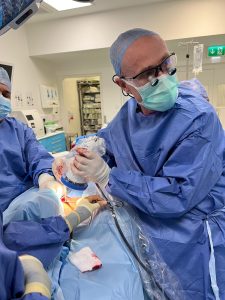
Professor Sheahan has performed over 400 dedicated parathyroid surgeries. Since 2025, all parathyroid surgeries performed by Professor Sheahan are performed under intraoperative PTH (ioPTH) control using the NBCL PTH analyzer. This means that during the operation, we test the PTH levels in your blood in real time, as we remove the abnormal parathyroids. This is the only foolproof way to avoiding leaving any hyperfunctioning parathyroid tissue behind. Since 2025 we have also been using near-infrared autofluorescence (NIRAF) for detection of parathyroids, using the Fluobeam NIRAF camera. This technique greatly aids parathyroid identification and has been extremely useful in trickier cases. Since the introduction of ioPTH control, we have reported a 98.1% success rate among 103 consecutive parathyroid surgeries, which compares with a 92.9% success rate among operations performed without ioPTH (data presented at Irish Head and Neck Society Meeting, May 21, 2026).
To read more about intraoperative PTH analyser, please click here
New parathyroid consultations with Professor Sheahan
Most patients with hyperparathyroidism should consult with an endocrinologist in the first instance to evaluate the severity of the hyperparathyroidism, assess for end-organ damage, and rule out secondary causes which might not respond to surgery, or which might alter the surgical approach. Once a referral has been made to Professor Sheahan, you will be given an appointment as soon as possible. In most cases your endocrinologist or GP will have sent all your results with the referral, however, if you are able to bring any additional blood results with you, this will be very useful.
At the consultation, Professor Sheahan will confirm the indications for surgery. At the same consultation, Professor Sheahan will perform videolaryngoscopy, which is a procedure to examine your larynx and vocal cords. This is an essential step in order as parathyroid surgery takes place in the very near vicinity of the larynx, and nerves supplying the vocal cords. You can also expect to undergo thyroid ultrasound. This may show the culprit parathyroid adenoma if this is arising from an inferior gland. Ultrasound is also essential to check for any thyroid nodules which require to be dealt with at the same time.
Prior to the actual surgery, you will likely require imaging studies (scans) to help localize the culprit parathyroid adenoma. Besides ultrasound, these may include either sestamibi scan, 4D parathyroid CT, or both. The latter is a special CT with a specialized protocol for detecting parathyroid glands, and because of this special protocol, we nearly always request that this is done in the South Infirmary due to the local expertise at performing and interpreting this scan. Professor Sheahan will advise which scans are required in your case.
Parathyroid surgery
Once all the scans are done, we will proceed with the surgery. We generally do this as a 1-night hospital stay. Thanks to the use of ioPTH, we are generally able to tell you immediately if we feel the operation has been successful or not.
After you go home, you should monitor for any signs of hypocalcaemia (calcium levels going below normal). This includes pins and needles or muscle cramps. You should come back to the hospital if this occurs so we can check your calcium and give you calcium if required. If you have no symptoms, you should visit your GP 3-4 days after the operation for a calcium blood test.
You will generally be given a review appointment around 6 weeks after surgery, when we will have all the final results, including the results of pathological examination of the specimen, and when we can have a final debrief of the outcome of surgery and any future follow-up.